
As a professional manufacturer of heavy-duty vehicle castings, We focuses on the R&D and production of high-quality chassis castings for heavy trucks and semi-trailers. Adhering to mature and stable green sand casting technology, the factory adopts a complete standardized casting process from raw material preparation to finished product inspection. Every production step is strictly controlled to ensure that chassis casting products feature high strength, high precision and stable performance, fully adapting to the harsh working conditions of heavy-load commercial vehicles.
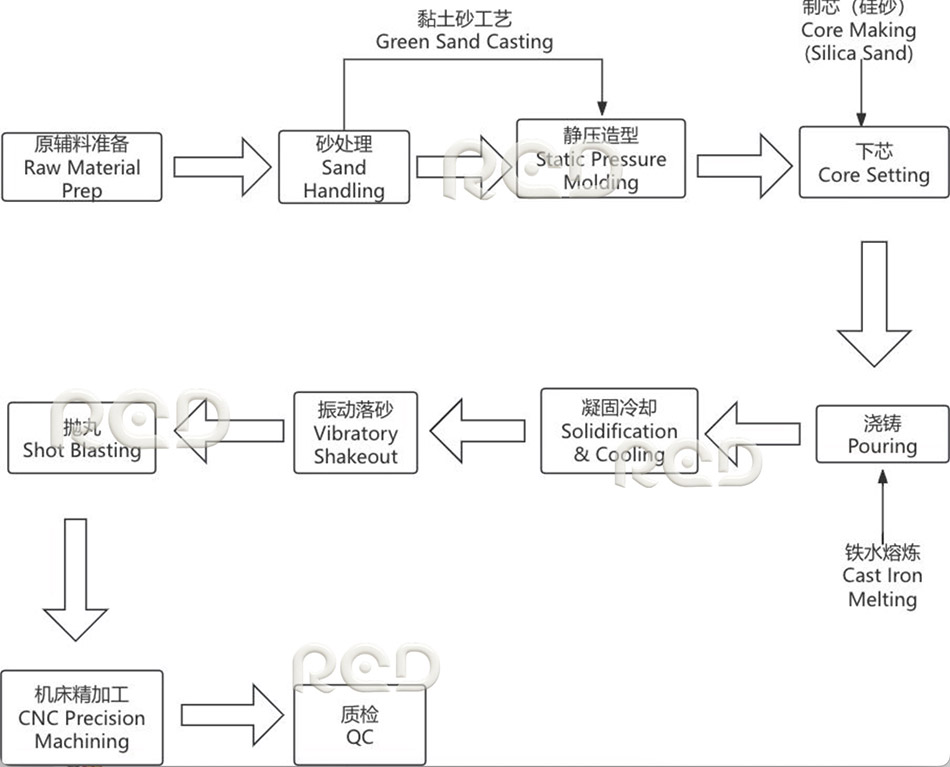
1. Raw Material Preparation
We selects high-quality pig iron and iron scrap as the core smelting raw materials. All raw materials are strictly screened and inspected before warehousing to remove impurities. Standardized raw material preparation ensures stable chemical composition and basic mechanical properties of molten iron, laying a reliable foundation for the quality of heavy truck chassis castings.
2. Sand Handling
The factory adopts mature green sand casting technology. Professional mixers are used to fully mix raw sand, bentonite and coal powder in precise proportions. The processed clay sand has excellent bonding strength, air permeability and plasticity, effectively avoiding common casting defects such as pores and sand holes, and ensuring the compactness and surface quality of castings.
3. Static Pressure Molding
We applies advanced static pressure molding technology, combining high-pressure air pre-compaction and hydraulic compaction. The molding sand is evenly filled and compacted in the mold to form high-strength and high-precision outer sand molds. This process stabilizes the overall shape of the sand mold, effectively improves the dimensional accuracy of casting outlines, and prevents deformation and size deviation during production.
4. Core Making & Core Setting
For the complex internal cavity structure of chassis parts, yellow sand is adopted for core making. The sand cores are formed and cured by core-shooting equipment to match the internal cavity size of castings accurately. Workers place the qualified sand cores precisely at the designated position of the lower sand box, which guarantees the consistency of the internal structure of castings and improves product stability and yield.
5. Locking & Combining
After core setting, the upper and lower sand boxes are accurately aligned and fastened with special fixtures and weights. This procedure effectively resists the strong buoyancy generated by high-temperature molten iron pouring, prevents the upper box from lifting, avoids molten iron leakage and casting size out-of-tolerance, and ensures complete and standard casting shape.
6. Cast Iron Melting
The factory uses professional electric melting equipment. The furnace materials are heated to 1350℃-1500℃, with a single furnace melting cycle of 45-50 minutes. After real-time temperature monitoring and composition testing, the qualified molten iron is transferred to the ladle for pouring, ensuring stable and reliable molten iron performance.
7. Pouring, Solidification & Cooling
The qualified molten iron is evenly poured into the assembled sand box to fully fill the mold cavity. The molten iron is cooled and solidified naturally in the sand mold, changing from liquid to solid casting blanks. Standard cooling procedures avoid cracks, shrinkage cavities and other defects, ensuring the internal structural compactness of chassis castings.
8. Vibratory Shakeout & Cleaning
After cooling and forming, the castings are processed by a vibrating conveyor to realizing thorough sand removal and providing clean blanks for subsequent finishing and processing.
9. Shot Blasting
We adopts professional shot blasting technology. High-speed steel shots blast the casting surface to thoroughly remove residual sand, oxide scale and burrs, effectively improving the surface hardness and wear resistance of chassis components.
10. CNC Precision Machining
To meet the high-precision assembly requirements of heavy-duty chassis parts, all casting blanks are processed by CNC precision machine tools. Precision procedures including cutting, drilling and thread tapping are completed to optimize product dimensions and ensure assembly accuracy.
11. QC Laboratory Testing
All finished products undergo strict laboratory testing. We use three-coordinate detection equipment to test roundness, cylindricity, coaxiality and other form and position tolerances. Auxiliary inspections such as surface roughness, appearance defects and wall thickness uniformity are also carried out. Qualified products are put into storage, while unqualified products are returned to the furnace for remelting.
With standardized processes and strict quality control, RED always provides high-reliability chassis casting accessories for heavy truck and semi-trailer industries.